
Counting the Omer is Torah Mitzvah 127: To count forty-nine days from the time of the cutting of the Omer (first sheaves of the barley harvest).
וּסְפַרְתֶּ֤ם לָכֶם֙ מִמָּחֳרַ֣ת הַשַּׁבָּ֔ת מִיּוֹם֙ הֲבִ֣יאֲכֶ֔ם אֶת־עֹ֖מֶר הַתְּנוּפָ֑ה שֶׁ֥בַע שַׁבָּת֖וֹת תְּמִימֹ֥ת תִּהְיֶֽינָה׃
And from the day on which you bring the sheaf of elevation offering—the day after the sabbath—you shall count off seven weeks. They must be complete.
עַ֣ד מִֽמָּחֳרַ֤ת הַשַּׁבָּת֙ הַשְּׁבִיעִ֔ת תִּסְפְּר֖וּ חֲמִשִּׁ֣ים י֑וֹם וְהִקְרַבְתֶּ֛ם מִנְחָ֥ה חֲדָשָׁ֖ה לַיהוָֽה׃
You must count until the day after the seventh week—fifty days; then you shall bring an offering of new grain to the LORD.
-- Leviticus 23:15-16
From the second night of Passover until the day before Shavuot, Jewish Tradition instructs us to observe the mitzvah of Sefirat HaOmer (counting of the Omer). The Torah instructs us that during this time each year we are to count seven complete weeks, for a total of 49 days. This is the counting of the omer. There are various customs surrounding this practice.
At the end of the seven-week period we celebrate Shavuot, a word meaning "weeks." For this reason Shavuot is often called the Festival of Weeks.
Important Note: Sefirat HaOmer is an important mitzvah for all Jews. The count, which takes place each night as the new day begins (remember we follow a lunar calendar), is preceded by a blessing. There are various rules associated with the counting.
For instance, if we fail to count before sunrise we are permitted to do the count during the day, only without the blessing. We then continue as normal the next night. Most authorities say that if one misses a complete day (i.e., they do not say the count for an entire day) they may continue the count however without the blessing until the next year. A minority opinion holds that they may not continue the count even without the blessing that year.
For this reason, it is important to recite the count on the correct night for the entire period. According to majority opinion, it is permitted to listen as a friend says the blessing and then do the counting. HaShem is merciful.
Why Do We Count These Days?
We learn several reasons. The most important is that the count demonstrates our excitement as we look forward to receiving the Torah on Shavuot. As we count these days we do so with excitement and emunah, confident that once again HaShem will reveal His Torah to us.
As we do the count we intend to be mindful that we are the Israelites who left Egypt with Moshe and are, once again, making our way to Mount Sinai. This elevated consciousness encourages us to purify ourselves, both physically and spiritually, for our upcoming encounter with King of all kings.
During this period we spiritually prepare and refine ourselves. Like the Israelites nearly 3,500 years ago, we have assimilated and embraced many of the immoral ways of the Egyptian (American etc) people. Like them, we must purge ourselves. We are aware that the Jews who left Egypt failed to accomplish this. As a result they died in the wilderness rather than being permitted to enter the Land of Promise.
As we count the omer we determine not to be like them. Our growing kavanah or intention to merit witnessing the coming of HaMashiach and the dawn of the Olam Haba, the Messianic World to Come. May this be the intention of all of our people!
During their forty-nine days between Pesach and Shavuot they underwent a radical transformation of consciousness. They witnessed the direct power and love of HaShem as no other generation had, and yet they created a golden calf and chose to return to slavery rather than place their emunah in HaShem alone. Likewise no generation since theirs has witnessed the power of HaShem so publicly displayed.
Not only have around half of the Jews been allowed by G-d to retake a portion of our Homeland, it was done with literal miracles! We continue to see miracles on Israel's behalf every day. Despite this, a large segment of our people exercise little to no emunah. Instead we remain a woefully divided people who look to the Gentile nations for our security. We are divided into rival movements. We even sometimes deny the "Jewishness" of our fellow Jews. Despite this, we have the audacity to say we believe in HaShem and desire His Theocratic rule over us.
May this Sefirat HaOmer be the time we cast off our lack of emunah! May all Jews use this opportunity to arise to devekut, attachment to HaShem and His people. May we all learn the lessons of Sefirat HaOmer. Then we will be a Light to Nations as described at Yeshayahu (Isaiah) chapter 49.
So said the Lord, the Redeemer of Israel, his Holy One, about him who is despised of men, about him whom the nation abhors, about a slave of rulers, "Kings shall see and arise, princes, and they shall prostrate themselves, for the sake of the Lord Who is faithful, the Holy One of Israel, and He chose you."
What Is An Omer?
- Noun: omer
- An ancient Hebrew dry measure, the tenth part of an ephah. This would be about 3.64 liters or 3.8 U.S. quarts.
- A sheaf of corn or omer of grain presented as an offering on the second day of Passover.
The period of 49 days between the second day of Pesach (Passover) and Shavu'ot (Pentecost).
Why Do We Keep Counting It?
The counting reminds us of the exodus from Egypt and everything included in that event. This includes G-d's might, judgments and love as well as our failures and missed opportunities. By keeping this memory alive we acknowledge that it is not too late! The greater exodus from slavery is still ahead of us. The final Redemption of our people could happen during our lifetime IF we seek HaShem and purify our consciousness (II Chronicles 7:14). It's not too late.
There Are Four "Worlds"
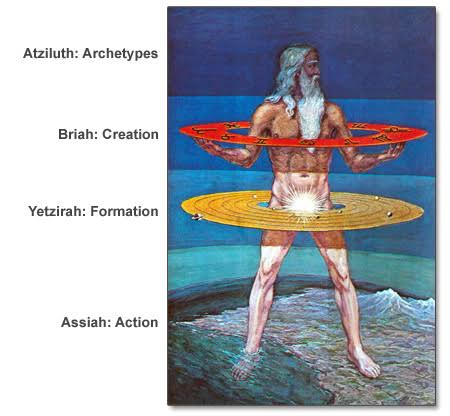
Our physical world consists of two components: One celestial and one terrestrial. The "celestial" includes the stars and planets, the physical heavens. The "terrestrial" is our realm, the physical earth. These two combine and comprise our physical "world." The world we see with eyes and experience (including through telescopes etc). In our pride we usually think our "world" is the totality of existence, but in truth it is but a minor realm within a limitless expanse. In this the wise are often foolish while the 'foolish' are wise. Due to their lack of emunah fools blind themselves to reality.
"Above" or beyond our finite realm is the world of the angels and other similar etheric entities. Their realm is much "larger" than ours by comparison, but it too is as nothing when compared with the totality of existence.
"Higher" and more expansive than the second and first worlds combined is the third. This is the world our sages sometimes refer to as the Realm of the Higher Forces. This world is also known as the World of the Throne or Merkabah. A slight glimpse into this realm is found in the Chariot Throne referenced by Prophet Yechezkel (Ezekiel) in chapter one of the book bearing his name. There is a mystical Jewish school dedicated to the study of the Merkabah.
All of these three worlds are teeming with diverse life forms or entities. Individualized existence is the Way of G-d. Each life form, each species, and each realm has its own nature of existence and its own degree of individuality. Each exists as created by the Holy One and each fulfills its purpose according to the will of the Creator.
One of these life forms is unique in terms of its individuality and free will according to the understanding of our sages. That being is humanity. Only humans were "created in the image of G-d." This image is not referring to physical characteristics. The Holy One has no such form. The image of G-d refers to our intellectual ability to choose our course. Because we were created with dual impulses (or yetzer) we choose between yetzer hatov and yetzer hara, between the positive and the negative impulses. This dual nature grants us free will.
By our free will we can elevate or diminish our consciousness. We can choose the path of light or the way of darkness. Those who choose to utilize the tools offered during the Sefirat HaOmer uncover the secrets of devekut, attachment to the Holy One, which is our collective destiny. As such people become increasingly attached to the Holy One their consciousness ascends upwards and they attain the consciousness of Kether, the "highest" of the sephirot.
With this attainment, "Kether becomes Malkuth of the next order" and soul gradually ascends from one world to the next.
"Higher" still, transcending the realm of the Merkabah or third world of conceptual existence, is the realm that can only be called a "world" in the most general sense. The Fourth Realm transcends all description. It encompasses realities we can only speak of in philosophical or allegorical terms because its Reality is so far beyond our finite comprehension as to be inconceivable. This is the Realm of Divine Influences. These emanations proceed from the Holy One (Blessed be He!) and fills all existence. From this Realm flows the transcendent revelations or emanations as luminous fibers of the One Light from which all existence comes and to which all existence inevitably returns.
"It has been clearly demonstrated to you that Sacred Name alone is G-d; there is none beside Him. From the heavens He let you hear His voice to discipline you; on earth He let you see His great fire; and from amidst that fire you heard His words. And because He loved your fathers, He chose their heirs after them; He Himself, in His great might, led you out of Egypt, to drive from your path nations greater and more populous than you, to take you into their land and assign it to you as a heritage, as is still the case. Know therefore this day and keep in mind that the LORD alone is God in heaven above and on earth below; there is no other (Deuteronomy 4:35-39)"
Other than the Holy One there is no existence! The Influences emanating from the Holy One can not be considered "entities" because nothing exists with the Holy One. There are therefore no gods, not demigods, no incarnations, and no mediators. There are no individual beings, phenomena, etc. in that Realm.
From this Fourth World emanates a spectrum of the Or Chadash or Sacred Light. This all inclusive Light emanates from the Holy One according to His Will due to His love for all creatures. Through this 'spectrum' of Sacred Light the inconceivable Holy One (Ain Soph) becomes conceivable as the King of the Merkabah described by Navi Ezekiel. The Holy One bestows existence, both particular and universal, to the creations of the lower worlds according to their diverse natures. Not all realms are the same, not all the entities are the same. HaShem provides to each according its own nature and needs through the emanations of His Holy Light.
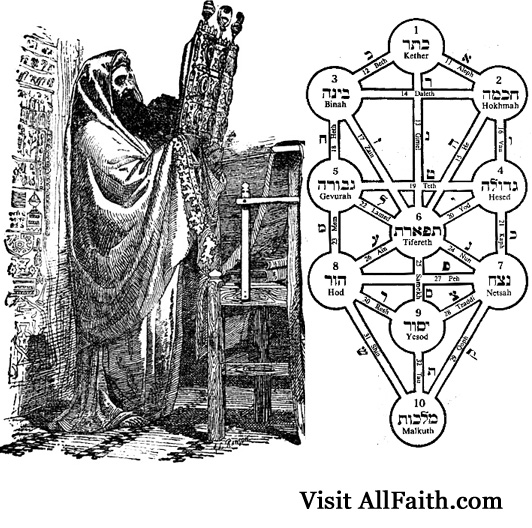
As a spectrum, the Emanations are One and yet can be categorized or conceptualized even as music is one and yet consists of diverse notes. Related to this concept is the Ten Utterances perceived in the first chapter of Bereshit-Genesis when the Elohim "said" "Let there be... and there was." The graphic above shows a tzaddik (a pious one) pondering Torah and realizing the Ten Emanations (Sephirot) of his being. Note that he is pondering them through Torah as if the scroll were a prism. All truth is revealed through HaTorah.
The Emanations exist both as the microcosm and macrocosm of existence. They are therefore conceived as the "Palace," "House," or Body of Adam Kadmon (original or primordial Man, not to be confused with Adam of Gan Eden). Adam Kadmon is humanity and its unique potential as mentioned above. Humanity is unique among the created beings. By actualizing the individual emanations or powers of the Tree of Life one is empowered to ascend ever higher as we attach ourselves more and more completely with the Holy One (Blessed be He!).
As one spiritually ascends or progresses, "Kether becomes Malkuth of the next order" and the process towards 'enlightenment' or at-one-ment with the Divine Light of the Or Chadash advances and one becomes ever more 'attached' to the Holy One, Who alone is both our Source and our Destination (Tehillim/Psalms 82). This process is what is being referenced in the counting of the Omer. The soul, enslaved by material desires and poor choices, arises as the Son or Daughter of the Most High as the personal unification of these emanations is merited and achieved.
For more on this topic see my study here.
For more information on Shavuot see my study here
⚠️ Important Warning
Having presented this very basic level of information in what I hope is an understandable fashion, I must also offer a serious warning as well:
While there is a vast wealth of wisdom and potential in studying proper mysticism, there are also serious potential dangers. Just as religions and diverse sects of "replacement theologies" have arisen seeking to replace the Jewish people and hoping to usurp the Jewish Covenant with HaShem, so too there are a LOT of counterfeit groups and individuals selling "Kabbalah" by various names. These groups need to be avoided at all costs lest they contaminate one's soul with avodah zarah (foreign ideologies)!
Real knowledge of these topics comes with strict rules about teacher and student qualifications, applications of learned materials, and so on. Those websites that claim to teach "New Age," "Practical," "Universal," and so versions of Kabbalah are not to be trusted in my opinion. To study these ancient Jewish topics one needs to be Jewish [this information is not for the other nations] and well versed in Torah, Tanach, Mishna, Talmud, etc. One also needs to be Torah Observant, Shomer Shabbat, and regularly engaged in hitbodedut (personal, secluded prayer and meditation with HaShem).
One needs to learn one on one, or in a small group, with an experienced master who is mature and knowledgeable in all these topics, and who possesses the applicable traits. Proper training in these areas is beyond the knowledge and ability of most Jews, even most rabbis. In my opinion, this negates anything you may find on the internet, other than basic descriptions such as I am sharing here.
There are a couple of introductory sources online, such as CHABAD's Kabbalah Online, but my advice is to not seek these materials online if at all. Please understand that this is not a field to be lightly dallying with. My personal suggestion is to focus on the teachings of Rebbe Nachman of Breslov and other expert Chassids. Rebbe Nachman in particular includes a lot of the core material in his teachings (and his stories especially) that will present these truths in ways that are uplifting and beneficial to one's spiritual development.
Note: Counting the Omer is a Jewish-only obligation. Non-Jews are not included in the counting.
Lag B'Omer
Lag B'Omer connects Pesach (exodus from slavery) to Shavu'ot (freedom from slavery through the giving of Torah). Pesach is instituted at: Leviticus 23:15 "And from the day on which you bring the sheaf of elevation offering—the day after the sabbath—you shall count off seven weeks. They must be complete: you must count until the day after the seventh week—fifty days; then you shall bring an offering of new grain to the LORD."
The Torah commands counting the days from Pesach to Shavu'ot. This period is known as the Counting of the Omer as discussed. There are several traditions surrounding the period including partial mourning. For this reason weddings, celebrations, parties etc. are forbidden, as are haircuts and unnecessary attention to normal grooming. Lag B'Omer is day 33 of the count. On this one day all of the restrictions are lifted. They resume the next day.
For more information on Lag B'Omer see my study HERE
Sefirat HaOmer ends on Shavuot. Shavuot is also known as Pentecost, the Festival of Weeks, Hag HaBikkurim (the Festival of First Fruits), and Hag Matan Torateinu (the Festival of the Giving of Torah).
Shavuot is observed for two days, beginning with the conclusion of 49 days or 7 full weeks. For information about Shavuot see my study HERE
While the counting of the omer is only required of Jews, everyone can benefit from the wisdom expressed in the daily counting and the encouragement to do soul searching as expressed through the application of the Emanations as described by our sages. Non-Jews may do the formal count but not the blessing. The reason for this restriction is that one should never speak falsely, especially before HaShem, and the words of the blessing are specifically applicable to Jews and not to other nations.
We Bow Before HaShem
We bow before HaShem with these ancient words:
לְשֵם יִחוּד קֻדְשָׁא בְּרִיךְ הוּא וּשְׁכִינְתֵּיהּ בִּדְחִילוּ וּרְחִימוּ, וּרְחִימוּ וּדְחִילוּ, לְיַחֵד שֵׁם יוּ"ד הֵ"א בְוָא"ו הֵ"א בְיִחוּדָא שְׁלִים בְּשֵׁם כָּל יִשְׂרָאֵל.
Behold, I am prepared and ready to perform the positive mitzvah of counting the Omer, as is written in your Torah: "You are to count from the end of the rest day (Pesach) when you brought the waived the Omer-offering. To the day after the seventh week, shall be seven complete weeks. Until the end of the seventh week you shall count fifty days."
וִיהִ֤י׀ נֹ֤עַם אֲדֹנָ֥י אֱלֹהֵ֗ינוּ עָ֫לֵ֥ינוּ וּמַעֲשֵׂ֣ה יָ֭דֵינוּ כּוֹנְנָ֥ה עָלֵ֑ינוּ וּֽמַעֲשֵׂ֥ה יָ֝דֵ֗ינוּ כּוֹנְנֵֽהוּ׃ תהילים צ:יז
May the pleasantness of the Lord our G-d be upon us. May G-d establish the work of our hands, our work, may G-d establish.
בָּרוּךְ אַתָּה יְיָ אֱלֹהֵֽינוּ מֶֽלֶךְ הָעוֹלָם אֲשֶׁר קִדְּשָֽׁנוּ בְּמִצְוֺתָיו וְצִוָּֽנוּ עַל סְפִירַת הָעֹֽמֶר׃
Blessed are you, HaShem our G-d, King of the Universe, who has sanctified us through His mitzvot and commanded us to count the omer.
יְהִי רָצוֹן מִלְּפָנֶיךָ יְיָ אֱלֹהֵינוּ וֵאלֹהֵי אֲבוֹתֵינוּ שֶׁיִּבָּנֶה בֵּית הַמִּקדָשׁ בִּמְהֵרָה בְיָמֵינוּ וְתֵן חֶלְקֵנוּ בְּתוֹרָתֶךָ׃
May it be Your will, HaShem our G-d, G-d of our ancestors, that the Beit HaMikdash be rebuilt speedily in our days, and may You grant us a portion in Your Torah.
Each night we begin with the blessing, if applicable (see above for when not to recite the blessing):
Barukh ata Adonai Eloheinu Melekh ha'Olam asher kid'shanu b'mitzvotav v'tizivanu al sefirat ha'omer
בָּרוּךְ אַתָּה יְיָ אֱלֹהֵֽינוּ מֶֽלֶךְ הָעוֹלָם אֲשֶׁר קִדְּשָֽׁנוּ בְּמִצְוֺתָיו וְצִוָּֽנוּ עַל סְפִירַת הָעֹֽמֶר׃
BA-RUCH A-TAH ADO-NAI E-LO-HE-NU ME-LECH HA-OLAM
ASHER KID-E-SHA-NU BE-MITZ-VO-TAV VETZI-VA-NU AL SEFI-RAT HA-OMER.
Blessed are You, Lord our God, King of the Universe,
Who has sanctified us with His commandments, and commanded us concerning the counting of the Omer.
Note the variation indicated by "ba-omer" or "la-omer" which refers to the two traditional texts in use for the Sefirat HaOmer. In one translation, "ba," the preposition is "in" as in "in the count of the Omer." In the other, "la," the preposition has the meaning "of" as in "of the Omer count." In the translations below, I use the "of" form, corresponding to "la," but in this technical matter of custom, ("ba" or "la"?), one should follow the practice (minhag) of his or her community.
After the blessing each day is counted along with the interaction of its emanation/quality as discussed above. By focusing on these qualities the daily count leads us to self examination and soul correction:
The ten Sefirot are our human perceptions of the manifestations of the One reality within the world. One way our sages seek to convey the inconceivable conception of the Holy One is Holy Light (Ohr Chadash). When considered in this way Ain Soph is conceived as manifesting Self as the Light of Creation into a dark world. Were this Light perceived directly Its radiance would blind us, as one staring directly into the physical sun. To protect us the Light is concealed and appears as prisms of Light. While each prism is in reality the manifestation of the Single Light, each takes on unique characteristics due to its being diffused. These prisms are emanations which we call sephirot (plural, sefirah singular). These sephirot should be conceived of as metaphorical conceptions and not taken too literally.
In truth, Ain Soph, and hence HaShem, is utterly and indivisibly echad or One. It is only for the purpose of expanding our conception of the inconceivable that we speak of G-d as a "Unity" and declare that there is no unity like His Unity. Howso? All other unity refers to more than a single thing as being joined or united, while His Unity is utterly One and indivisible.
We have a clear indication that we are using a metaphor by the use of the number ten. Kabbalah, like the material universes themselves, may be thought of in mathematical terms. The number ten is a completion recognized by most ancient cultures. Single digits become doubled beginning with 10. With the ten fingers of our hands we are commanded to "do" HaTorah.
More specifically, when the Holy One determined to perform the act of creation it is said that He uttered Ten Hebrew Words. These Ten Utterances are indicative of the Ten Sephirot and suggest their creative power. It is in part for the revelation of this secret that the Holy One said "Let us" and so on.
The creation is not something once done and then abandoned as conceived by the Deists. Rather it is the constantly occurring action of calling forth from the Primal Reality. We refer to this primal reality as Adam Kadmon, the first spiritual World that was spoken into being following the contraction of G-d's Infinite Light. Adam Kadmon must not be confused with Adam Ha-Rishon (the Adam of the Garden of Eden).
For those with understanding, we are part of this ten-fold process of creation. The ten Sephirot may be likened to a toolbox. HaShem has given us a 'toolchest' with which to assist in the ultimate goal of His creation. In this humanity is unique. The perfection of creation will be experienced once the Olam Haba or World to Come is fully established. Glimpses of this time beyond time can be experienced even now by those who are properly attached (devekut) to the Creator. The goal of Kabbalah and all real Jewish mysticism is to empower the souls, the children of the Most High, to achieve this state of consciousness and to assist in the final Redemption. It is with this understanding that we unlock Tehilim 82:
A tehilim of Asaph. G-d stands in the divine assembly; among the divine beings He pronounces judgment.
How long will you judge perversely, showing favor to the wicked? Selah.
Judge the wretched and the orphan, vindicate the lowly and the poor,
rescue the wretched and the needy; save them from the hand of the wicked.
They neither know nor understand, they go about in darkness; all the foundations of the earth totter.
I had taken you for divine beings, sons of the Most High, all of you;
but you shall die as men do, fall like any prince.
Arise, O God, judge the earth, for all the nations are Your possession.
The following are stored, as it were, within the Divine 'toolbox' as sacred emanations of the One Light.
The Ten Sefirot
- Keter – crown: Rational
- Chochmah - wisdom: Rational, mental infusion
- Binah - understanding (rational)
(Da'at -- knowing) - Chessed - kindness: (active)
- Gevura - strength: (active)
- Tiferet - beauty (active)
- Netzach - victory (preparation)
- Hod - awe (preparation)
- Yesod - foundation (preparation)
- Malchut - monarchy/sovereignty
During the annual counting of the omer we focus on the lower seven Sefirot and their various attributes. Each day of the count we seek to develop and harmonize these seven attributes within our own consciousness. Each of these is part of our divine heritage as the Children of the Most High. We are after all the princes and princesses of the High King. His Will is that we master these qualities in His service for the well-being of all existence:
The Seven Emotional Attributes
- Chesed - Loving-Kindness
- Gevurah - Justice and Discipline
- Tiferet - Harmony, Beauty, Compassion
- Netzach - Endurance, Eternity
- Hod - Humility and Splendor
- Yesod - Bonding, bringing to Fruition
- Malchut - Sovereignty, Leadership
Above Chessed is Da'at, Binah, Chochmah and Keter, known as the 'Upper Triad' (excluding Da'at which has certain unique properties). These attributes are referenced in my daily guide to the Omer Count and elsewhere.
Think of a human being who is a judge. Wrong-doers stand before him in fear while the innocent look to him hopefully as their protector. To his wife he is husband, soul mate, trusted confidant, lover, and someone who keeps forgetting to take the trash can out to curb on Mondays. To his children he is dad, baseball partner, joke teller, religious instructor, allowance provider, he-who-must-be-answered for a bad report card or deed. To his friends he is a buddy, and so on. He is but one man however he is viewed in completely different ways depending on which role he fulfilling and to whom. In the same way we interact with the Holy One in many different ways.
The Sephirot can be thought of in this way as well. Each represents a different aspect or role of the total, which is Ain Soph. There exist within the seven sephirot innumerable applications to every aspect of existence. It is said that we "climb this tree" upward from Malchut to Chesed over and over again until we unlock the knowing of Da'at. Belief is not the same thing as knowing. The child believes the parent's warning that the stove is hot and yet may eventually touch it despite the belief. Once the child is burned he knows what 'hot' really means and avoids the experience again. Da'at is 'knowing'.
Once a degree of 'knowing' is achieved one continues into the upper triad. Blessed is one who attains to Keter, wherein 'Keter becomes Malchut of the next order' and the soul continues its endless journey of devekut, attachment to and with the Eternal. Following is the Daily Omer overview. For the specific daily contemplations See Here.
| The Count | The Emanations |
|---|---|
| 1 Ha-yom yom e-chad ba-omer (or la-omer) Today is one day of the Omer | Day One: Chesed of Chesed 1st Day of the Omer |
| 2 Ha-yom sh'nay yamim ba-omer (or la-omer) Today is two days of the Omer | Day Two: Gevurah of Chesed 2nd Day of the Omer |
| 3 Ha-yom sh'losha yamim ba-omer (or la-omer) Today is three days of the Omer | Day Three: Tiferet of Chesed 3rd Day of the Omer |
| 4 Ha-yom arba-a yamim ba-omer (or la-omer) Today is four days of the Omer | Day Four: Netzach of Chesed 4th Day of the Omer |
| 5 Ha-yom chami-sha yamim ba-omer (or la-omer) Today is five days of the Omer | Day Five: Hod of Chesed 5th Day of the Omer |
| 6 Ha-yom shi-sha yamim ba-omer (or la-omer) Today is six days of the Omer | Day Six: Yesod of Chesed 6th Day of the Omer |
| 7 Ha-yom shiv-a yamim, shehaym shavu-a e-chad ba-omer (or la-omer) Today is seven days, which are one week of the Omer | Day Seven: Malchut of Chesed 7th Day of the Omer |
| 8 Ha-yom sh'mona yamim, shehaym shavu-a e-chad v'yom e-chad ba-omer (or la-omer) Today is eight days, which are one week and one day of the Omer | Day One of Week 2: Chesed of Gevurah 8th Day of the Omer |
| 9 Ha-yom tish-a yamim, shehaym shavu-a e-chad ushnay yamim ba-omer (or la-omer) Today is nine days, which are one week and two days of the Omer | Day Two of Week 2: Gevurah of Gevurah 9th Day of the Omer |
| 10 Ha-yom asara yamim, shehaym shavu-a echad ushlosha yamim ba-omer (or la-omer) Today is ten days, which are one week and three days of the Omer | Day Three of Week 2: Tiferet of Gevurah 10th Day of the Omer |
| 11 Ha-yom achad asar yom, shehaym shavu-a echad v'arba-a yamim ba-omer (or la-omer) Today is eleven days, which are one week and four days of the Omer | Day Four of Week 2: Netzach of Gevurah 11th Day of the Omer |
| 12 Ha-yom sh'naym asar yom, shehaym shavu-a echad vachami-sha yamim ba-omer (or la-omer) Today is twelve days, which are one week and five days of the Omer | Day Five of Week 2: Hod of Gevurah 12th Day of the Omer |
| 13 Ha-yom sh'losha asar yom, shehaym shavu-a echad v'shisha yamim ba-omer (or la-omer) Today is thirteen days, which are one week and six days of the Omer | Day Six of Week 2: Yesod of Gevurah 13th Day of the Omer |
| 14 Ha-yom arba-a asar yom, shehaym sh'nay shavuot ba-omer (or la-omer) Today is fourteen days, which are two weeks of the Omer | Day Seven of Week 2: Malchut of Gevurah 14th Day of the Omer |
| 15 Ha-yom chami-sha asar yom, shehaym sh'nay shavuot v'yom echad ba-omer (or la-omer) Today is fifteen days, which are two weeks and one day of the Omer | Day One of Week 3: Chesed of Tiferet 15th Day of the Omer |
| 16 Ha-yom shi-sha asar yom, shehaym sh'nay shavuot ushnay yamim ba-omer (or la-omer) Today is sixteen days, which are two weeks and two days of the Omer | Day Two of Week 3: Gevurah of Tiferet 16th Day of the Omer |
| 17 Ha-yom shiva asar yom, shehaym sh'nay shavuot ushlosha yamim ba-omer (or la-omer) Today is seventeen days, which are two weeks and three days of the Omer | Day Three of Week 3: Tiferet of Tiferet 17th Day of the Omer |
| 18 Ha-yom shemonah asar yom, shehaym sh'nay shavuot v'arba-a yamim ba-omer (or la-omer) Today is eighteen days, which are two weeks and four days of the Omer | Day Four of Week 3: Netzach of Tiferet 18th Day of the Omer |
| 19 Ha-yom tisha asar yom, shehaym sh'nay shavuot va'chamisha yamim ba-omer (or la-omer) Today is nineteen days, which are two weeks and five days of the Omer | Day Five of Week 3: Hod of Tiferet 19th Day of the Omer |
| 20 Ha-yom esrim yom, shehaym sh'nay shavuot v'shi-sha yamim ba-omer (or la-omer) Today is twenty days, which are two weeks and six days of the Omer | Day Six of Week 3: Yesod of Tiferet 20th Day of the Omer |
| 21 Ha-yom e-chad v'esrim yom, shehaym shlosha shavuot ba-omer (or la-omer) Today is twenty-one days, which are three weeks of the Omer | Day Seven of Week 3: Malchut of Tiferet 21st Day of the Omer |
| 22 Ha-yom sh'nayim v'esrim yom, shehaym shelosha shavuot v'yom echad ba-omer (or la-omer) Today is twenty-two days, which are three weeks and one day of the Omer | Day One of Week 4: Chesed of Netzach 22nd Day of the Omer |
| 23 Ha-yom sh'losha v'esrim yom, shehaym shelosha shavuot ushnay yamim ba-omer (or la-omer) Today is twenty-three days, which are three weeks and two days of the Omer | Day Two of Week 4: Gevurah of Netzach 23rd Day of the Omer |
| 24 Ha-yom arba-a v'esrim yom, shehaym shelosha shavuot u'shelosha yamim ba-omer (or la-omer) Today is twenty-four days, which are three weeks and three days of the Omer | Day Three of Week 4: Tiferet of Netzach 24th Day of the Omer |
| 25 Ha-yom chami-sha v'esrim yom, shehaym shelosha shavuot v'arba-a yamim ba-omer (or la-omer) Today is twenty-five days, which are three weeks and four days of the Omer | Day Four of Week 4: Netzach of Netzach 25th Day of the Omer |
| 26 Ha-yom shi-sha v'esrim yom, shehaym shelosha shavuot va-chamisha yamim ba-omer (or la-omer) Today is twenty-six days, which are three weeks and five days of the Omer | Day Five of Week 4: Hod of Netzach 26th Day of the Omer |
| 27 Ha-yom shiva v'esrim yom, shehaym shelosha shavuot v'shi-sha yamim ba-omer (or la-omer) Today is twenty-seven days, which are three weeks and six days of the Omer | Day Six of Week 4: Yesod of Netzach 27th Day of the Omer |
| 28 Ha-yom shemonah v'esrim yom, shehaym arba-a shavuot ba-omer (or la-omer) Today is twenty-eight days, which are four weeks of the Omer | Day Seven of Week 4: Malchus of Netzach 28th Day of the Omer |
| 29 Ha-yom tisha v'esrim yom, shehaym arba-a shavuot v'yom e-chad ba-omer (or la-omer) Today is twenty-nine days, which are four weeks and one day of the Omer | Day One of Week 5: Chesed of Hod 29th Day of the Omer |
| 30 Ha-yom shloshim yom, shehaym arba-a shavuot ushnay yamim ba-omer (or la-omer) Today is thirty days, which are four weeks and two days of the Omer | Day Two of Week 5: Gevurah of Hod 30th Day of the Omer |
| 31 Ha-yom e-chad u'sheloshim yom, shehaym arba-a shavuot u'shelosha yamim ba-omer (or la-omer) Today is thirty-one days, which are four weeks and three days of the Omer | Day Three of Week 5: Tiferet of Hod 31st Day of the Omer |
| 32 Ha-yom sh'nayim u'sheloshim yom, shehaym arba-a shavuot v'arba-a yamim ba-omer (or la-omer) Today is thirty-two days, which are four weeks and four days of the Omer | Day Four of Week 5: Netzach of Hod 32nd Day of the Omer |
| *** Lag Ba'Omer *** | |
| 33 Ha-yom sh'losha u'sheloshim yom, shehaym arba-a shavuot vachamisha yamim ba-omer (or la-omer) Today is thirty-three days, which are four weeks and five days of the Omer | Day Five of Week 5: Hod of Hod Lag BaOmer - 33rd Day of the Omer |
| 34 Ha-yom arba-a u'sheloshim yom, shehaym arba-a shavuot v'shi-sha yamim ba-omer (or la-omer) Today is thirty-four days, which are four weeks and six days of the Omer | Day Six of Week 5: Yesod of Hod 34th Day of the Omer |
| 35 Ha-yom chami-sha u'sheloshim yom, shehaym chami-sha shavuot ba-omer (or la-omer) Today is thirty-five days, which are five weeks of the Omer | Day Seven of Week 5: Malchut of Hod 35th Day of the Omer |
| 36 Ha-yom shi-sha u'sheloshim yom, shehaym chami-sha shavuot v'yom echad ba-omer (or la-omer) Today is thirty-six days, which are five weeks and one day of the Omer | Day One of Week 6: Chesed of Yesod 36th Day of the Omer |
| 37 Ha-yom shiva u'sheloshim yom, shehaym chami-sha shavuot ushnay yamim ba-omer (or la-omer) Today is thirty-seven days, which are five weeks and two days of the Omer | Day Two of Week 6: Gevurah of Yesod 37th Day of the Omer |
| 38 Ha-yom shemonah u'sheloshim yom, shehaym chami-sha shavuot u'shelosha yamim ba-omer (or la-omer) Today is thirty-eight days, which are five weeks and three days of the Omer | Day Three of Week 6: Tiferet of Yesod 38th Day of the Omer |
| 39 Ha-yom tisha u'sheloshim yom, shehaym chami-sha shavuot va'arba-a yamim ba-omer (or la-omer) Today is thirty-nine days, which are five weeks and four days of the Omer | Day Four of Week 6: Netzach of Yesod 39th Day of the Omer |
| 40 Ha-yom arba-im yom, shehaym chami-sha shavuot va'chamisha yamim ba-omer (or la-omer) Today is forty days, which are five weeks and five days of the Omer | Day Five of Week 6: Hod of Yesod 40th Day of the Omer |
| 41 Ha-yom e-chad v'arbaim yom, shehaym chami-sha shavuot v'shi-sha yamim ba-omer (or la-omer) Today is forty-one days, which are five weeks and six days of the Omer | Day Six of Week 6: Yesod of Yesod 41st Day of the Omer |
| 42 Ha-yom sh'nayim v'arbaim yom, shehaym shi-sha shavuot ba-omer (or la-omer) Today is forty-two days, which are six weeks of the Omer | Day Seven of Week 6: Malchut of Yesod 42nd Day of the Omer |
| 43 Ha-yom sh'losha v'arbaim yom, shehaym shi-sha shavuot v'yom e-chad ba-omer (or la-omer) Today is forty-three days, which are six weeks and one day of the Omer | Day One of Week 7: Chesed of Malchut 43rd Day of the Omer |
| 44 Ha-yom arba-a v'arbaim yom, shehaym shi-sha shavuot ushnay yamim ba-omer (or la-omer) Today is forty-four days, which are six weeks and two days of the Omer | Day Two of Week 7: Gevurah of Malchut 44th Day of the Omer |
| 45 Ha-yom chami-sha v'arbaim yom, shehaym shi-sha shavuot u'shelosha yamim ba-omer (or la-omer) Today is forty-five days, which are six weeks and three days of the Omer | Day Three of Week 7: Tiferet of Malchut 45th Day of the Omer |
| 46 Ha-yom shi-sha v'arbaim yom, shehaym shi-sha shavuot v'arba-a yamim ba-omer (or la-omer) Today is forty-six days, which are six weeks and four days of the Omer | Day Four of Week 7: Netzach of Malchut 46th Day of the Omer |
| 47 Ha-yom shiva v'arbaim yom, shehaym shi-sha shavuot va'chami-sha yamim ba-omer (or la-omer) Today is forty-seven days, which are six weeks and five days of the Omer | Day Five of Week 7: Hod of Malchut 47th Day of the Omer |
| 48 Ha-yom shemonah v'arbaim yom, shehaym shi-sha shavuot v'shi-sha yamim ba-omer (or la-omer) Today is forty-eight days, which are six weeks and six days of the Omer | Day Six of Week 7: Yesod of Malchut 48th Day of the Omer |
| 49 Ha-yom tisha v'arbaim yom, shehaym shiv-a shavuot ba-omer (or la-omer) Today is forty-nine days, which are seven weeks of the Omer | Day Seven of Week 7: Malchut of Malchut 49th Day of the Omer |
Today is forty-nine days, which are seven weeks of the Omer
49th Day of the Omer
John of AllFaith's Daily Omer Meditations
Sources considered: Breslov.org, Orthodox Union, Chabad, Aish.com, MyJewishLearning.com

Got Questions or Comments?
Let me know
© By John of AllFaith, April 14, 2015 (last updated July 28, 2026)